Sport News
Read the latest news and updates
Manchester City Prediction Profile: How to Read Their Fixtures
5th Oct, 2026
By Martin · Published 5th October 2026 · Last updated 5th October 2026
Quick answer: Manchester City are the most possession-dominant side in the Premier League and one of the more structured to predict, though a summer managerial change adds fresh uncertainty. They started 2026-27 with a perfect 5 wins from 5 (15 points, +8) under new manager Enzo Maresca, after finishing 2nd in 2025-26 with 78 points, a +42 goal difference, 16 clean sheets, and league-leading possession around 60.6%. The durable patterns are heavy ball control, strong home form (W14 D3 L2 last season), and a tendency to dominate weaker sides while tightening in big games. AMpredict weights their possession control and home strength heavily, while treating the new-manager transition as the main caveat.
For over a decade, Manchester City were the closest thing the Premier League had to a sure thing.
Pep Guardiola built a machine that controlled games through possession, suffocated opponents, and won title after title. That era ended this summer: Guardiola resigned, and Enzo Maresca has taken over. So City enter 2026-27 as both the most recognisable tactical identity in England and, for the first time in years, a team with a genuine question mark over it.
This profile breaks down how to read Manchester City's fixtures for the 2026-27 season, anchored on the proven patterns from 2025-26. It's built to be updated through the year, with the durable traits leading and the early-season form, plus the managerial change, read with appropriate caution.
How are Manchester City starting the 2026-27 season?
Manchester City have started 2026-27 perfectly, winning all 5 of their opening league matches for 15 points, scoring 13 and conceding 5, with a +8 goal difference that put them top of the table and gave them the longest winning run in the division. The strong start suggests the transition from Guardiola to Enzo Maresca has been smoother than many expected.
Early highlights include a 1-0 win away at Manchester United and a 5-3 victory over Sunderland, the highest-scoring Premier League game of the season so far.
Five matches is a small sample, though, and a perfect start is exactly the kind of result that invites over-extrapolation. Winning five in a row doesn't guarantee the level holds, and the smart approach is to weight City's long-run patterns more heavily than a handful of games, a discipline rooted in regression to the mean. The added wrinkle this season is the new manager: until Maresca's City has a larger body of work, their fixtures carry more uncertainty than a settled Guardiola side did.
What did Manchester City's 2025-26 season tell us?
Manchester City's 2025-26 season confirmed their identity as a control-based side, finishing 2nd with 78 points, a +42 goal difference, 77 goals scored and just 35 conceded, with 16 clean sheets across the campaign. They were pipped to the title by Arsenal but remained the league's benchmark for dominating matches through the ball.
The defining number is possession: City led the league at roughly 60.6%, the clearest statistical signature of how they play.
| Metric | 2025-26 (final) | 2026-27 (through MD5) |
|---|---|---|
| League position | 2nd | 1st |
| Record | W23 D9 L6 | W5 D0 L0 |
| Points | 78 | 15 |
| Goal difference | +42 | +8 |
| Clean sheets | 16 | — |
The takeaway for predictors is that City win by controlling territory and starving opponents of the ball, not by trading chances. That style produces a recognisable fixture profile: lots of City possession, lots of City shots, and opponents pinned deep. It's the most stable tactical identity in the league, which is usually good for prediction, with the caveat that a new manager can shift the details.
Does possession dominance make Manchester City easy to predict?
Possession dominance makes some things about Manchester City predictable and others less so. Their control of the ball (around 60.6% last season, the highest in the league) reliably produces territorial dominance and plenty of shots, but possession alone is a weak predictor of the actual result, because dominating the ball does not guarantee goals against a packed defence.
This is the key nuance that trips up casual City predictions. People see 65% possession and assume a comfortable win, but possession is one of the least reliable predictors in football.
As our breakdown of why possession statistics mislead predictors explains, a team can dominate the ball and still fail to break down a disciplined low block. City's own history is full of games where they enjoyed 70% of the ball and dropped points to a side that defended deep and hit them on the break. So the useful read isn't the possession figure itself, it's whether City are converting that control into high-quality chances, which is where expected goals matters far more. For shot-level detail on any City fixture, Understat's xG data and FBref's City page are the cleanest free sources.
What are Manchester City's home and away patterns?
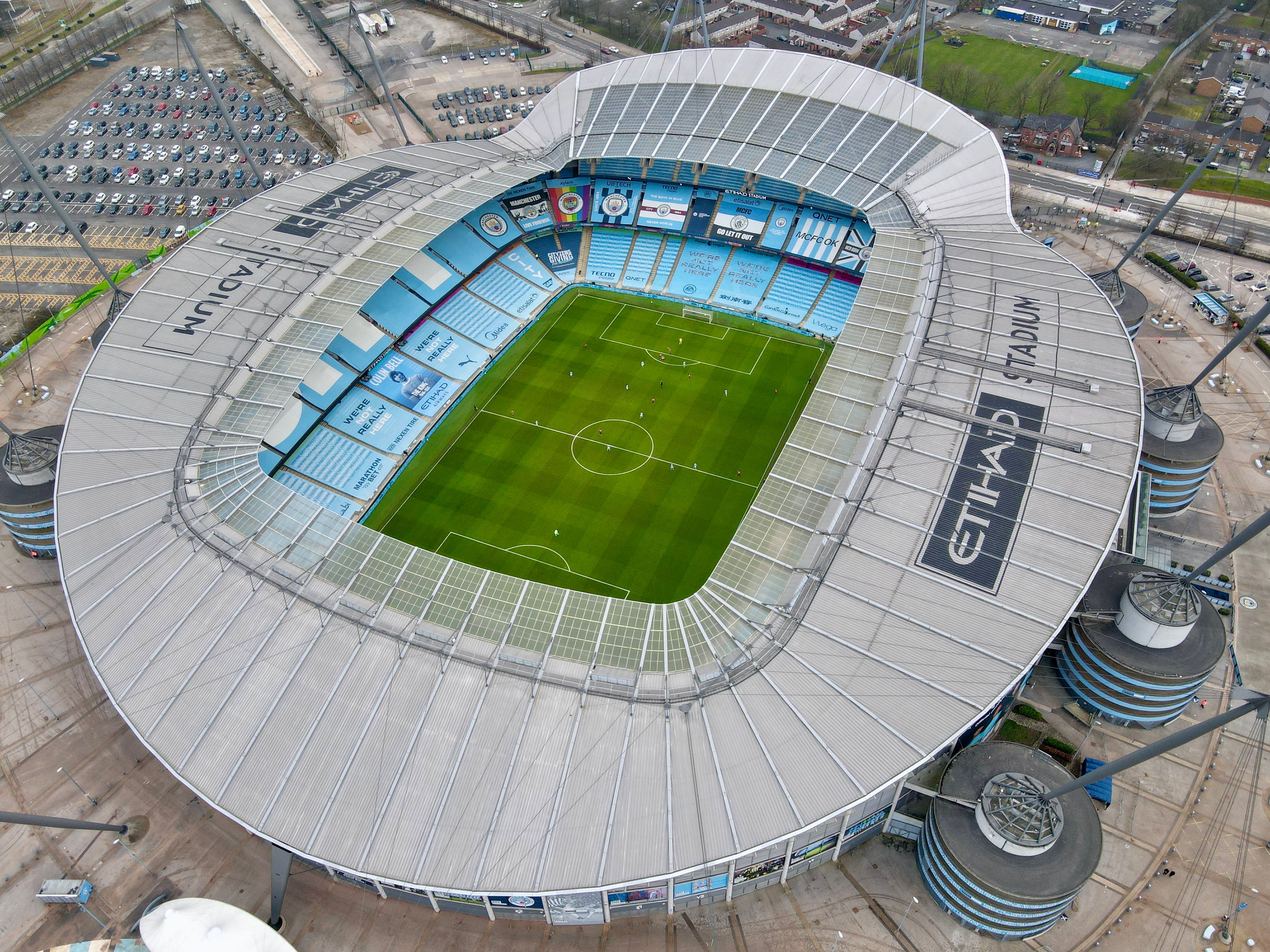
Manchester City are considerably stronger at home than away, posting a 2025-26 home record of 14 wins, 3 draws, and 2 losses against an away record of 9 wins, 6 draws, and 4 losses. The home-away gap is a core prediction input: the Etihad is a fortress, while their away form produces more draws and the occasional upset.
The split tells you where City's reliability lives and where the risk creeps in.
| Venue | 2025-26 Record | Points | Read for Predictions |
|---|---|---|---|
| Home | W14 D3 L2 | 45 | Fortress; strong win and clean-sheet lean |
| Away | W9 D6 L4 | 33 | More draws and dropped points; higher upset risk |
At home, backing City to win or at least not lose has been a high-probability play. Away, the picture is noisier: nine wins but six draws shows how often they control a game without finishing it off on the road. Their notable 2025-26 away loss to Aston Villa (0-1) is the kind of result that recurs when City dominate possession but can't convert. This home-away divergence is exactly the sort of split the Premier League prediction guide flags as more predictive than overall form.
How do Manchester City perform in cups versus the league?
Manchester City typically treat cup competitions differently from the league, rotating their squad heavily in early domestic cup rounds while prioritising the Premier League and Champions League. For predictions, this means City's cup fixtures, especially early-round domestic ties, are less reliable to forecast, because the team that takes the field may be very different from their first-choice league XI.
City's squad depth lets them rotate aggressively, and their 5-0 Carabao Cup win over Norwich in September 2026 came with changes from the league side.
The practical rule is to treat competition context as a major variable in any City prediction. In the league and in Champions League knockouts, you can expect something close to the strongest available team. In early domestic cup rounds, you should expect rotation, which lowers predictability and can produce surprise results against lower-league opposition. This kind of lineup uncertainty is precisely why human review matters so much in prediction, catching the rotation that models alone miss, a point made in full in why human review still beats pure AI. SofaScore's Manchester City match analysis is useful for checking expected lineups and rotation patterns fixture by fixture.
How does the new manager affect Manchester City predictions?
The managerial change from Pep Guardiola to Enzo Maresca is the single biggest new variable in Manchester City predictions for 2026-27. A new manager, even one inheriting a strong squad, introduces tactical and selection uncertainty that reduces how confidently any model can forecast City's fixtures until a larger body of work builds up.
So far the transition looks smooth, with five straight wins to open the season, but five games is not enough to assume the patterns are settled.
New managers typically take time to fully impose their ideas, and early results can flatter or mislead before the true level emerges. For prediction, this means City's 2025-26 patterns remain the best baseline, but they should be applied with a wider margin of uncertainty than they would be under a long-tenured manager. A new-manager situation is one of the clearest cases where a prediction should carry lower confidence rather than false certainty, because sure wins are mathematically impossible at the best of times, let alone during a transition.
How does AMpredict model Manchester City fixtures?
AMpredict models Manchester City fixtures using its three-layer methodology, weighting their possession control, chance quality, and strong home record heavily, while widening the uncertainty band to account for the new manager and heavy cup rotation. The mathematical layer leans on their territorial dominance and clean-sheet tendency, the AI layer flags their away-day draw risk, and human review tracks Maresca's selection and rotation decisions.
For a side this structured, the model has plenty of reliable signal, with two specific adjustments.
First, it discounts raw possession in favour of chance quality, because City's control doesn't always convert, especially against deep defences. Second, it treats competition context as a major variable, expecting rotation in early domestic cups and full strength in the league and Champions League knockouts. Every City prediction carries a calibrated confidence figure rather than a blanket "sure win," and during the managerial transition those figures run more conservative than they would for a settled side. The full set of City fixture predictions sits inside the VIP packages, sorted by confidence tier.
The Bottom Line
Manchester City remain the Premier League's benchmark for control, dominating matches through possession (around 60.6% last season), strong at home (W14 D3 L2 in 2025-26), and defensively solid with 16 clean sheets. Those durable traits make much of their fixture profile predictable, and a perfect 5-from-5 start to 2026-27 under Enzo Maresca suggests the squad's quality has carried through the managerial change.
The caveats are what separate a good City prediction from a lazy one. Possession alone doesn't guarantee goals, so chance quality matters more than the ball-share figure. Their away form produces more draws and the odd upset. Cup rotation lowers predictability in early rounds. And a new manager widens the uncertainty until a larger sample builds.
AMpredict weights City's control and home strength as high-confidence signals, while treating the managerial transition and cup rotation as the main reasons to keep confidence honest rather than inflated.
Want Manchester City fixtures predicted on real patterns, not reputation? See AMpredict membership pricing and get every City match run through the full three-layer methodology before kickoff.